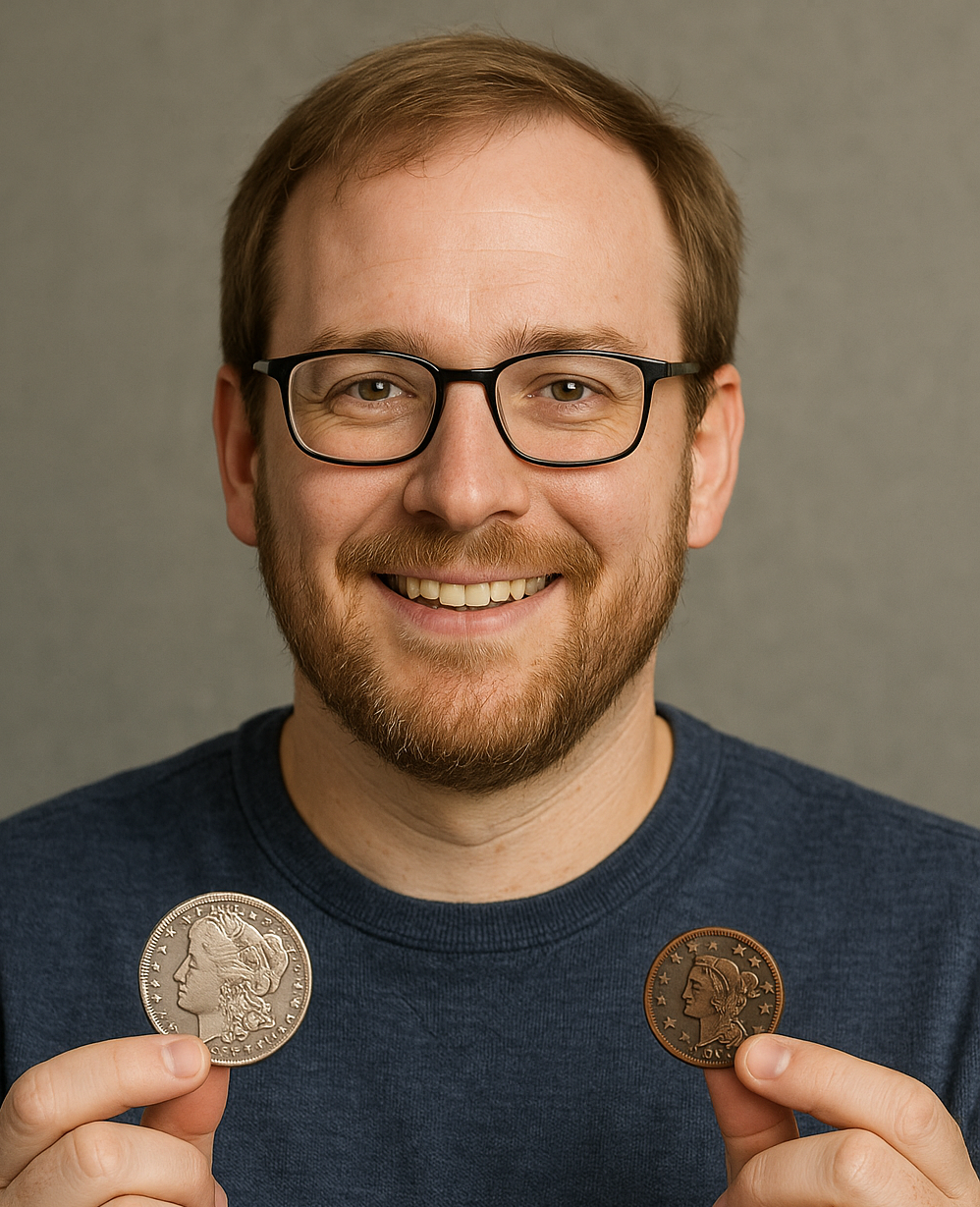
The Morgan Dollar: Everything a Beginner Needs to Know
Maybe you found them in a box at the back of a closet. Maybe your grandfather left them to you, wrapped in old cloth or tucked inside a coffee can. Maybe someone handed you a handful of large silver coins and said "these might be worth something" — and now you're sitting here wondering if that's actually true.
If that's you, I want you to take a breath. Because what you're holding is probably one of the most beloved coins in American history. And yes — they are almost certainly worth something.
The Morgan Dollar has a way of showing up in inherited collections more than almost any other coin. And every time someone finds one, they have the same questions: What is this? Is it valuable? What do I do with it?
Let me walk you through everything you need to know.
What Is a Morgan Dollar?
The Morgan Dollar is a large silver coin that was minted by the United States from 1878 to 1904, and then again for one final year in 1921. It's named after George T. Morgan, the assistant engraver at the U.S. Mint who designed it.
On the front, you'll see Lady Liberty in profile, wearing a crown of wheat and cotton. On the back, there's an eagle with outstretched wings, clutching arrows and an olive branch. It's a bold, beautiful coin — and at 38.1mm across, it has real weight and presence in your hand.
Each Morgan Dollar contains .7735 ounces of pure silver. At today's silver prices, that alone gives every single Morgan Dollar a base value — even the most common ones, even the ones in rough shape.
That's the first thing I want you to understand: there is no such thing as a worthless Morgan Dollar.
Why Morgan Dollars Show Up in So Many Collections
Here's something I really want you to hear. If you found Morgan Dollars in an older relative's belongings, you're not alone — and it's not a coincidence.
Morgan Dollars were minted in enormous quantities. Hundreds of millions of them. They circulated widely across the American West, which is why they're sometimes called "cartwheels" — big, heavy silver dollars that rang out when they hit a bar counter or a poker table.
When the silver standard ended and paper money took over, a lot of people held onto their Morgan Dollars. They felt like real money. Substantial. Worth keeping. So they got tucked into dresser drawers and safe deposit boxes and coffee cans, passed down from one generation to the next.
That's why you're finding them now. And that history is part of what makes them so special.
Are Morgan Dollars Valuable?
Here's the honest answer: it depends — but the floor is higher than most people expect.
Every Morgan Dollar has what collectors call melt value — the raw value of the silver inside it. With silver prices fluctuating, a common Morgan Dollar is typically worth somewhere in the $25–$35 range just for the metal, sometimes more. That's the baseline. Even the most worn, most common date is worth at least that.
From there, value goes up based on a few things.
Date and mint mark. Look on the back of the coin, just below the eagle's tail feathers. You'll see a small letter — or no letter at all. That's the mint mark.
No mint mark = Philadelphia
CC = Carson City
O = New Orleans
S = San Francisco
D = Denver (1921 only)
Carson City Morgans (CC) are almost always worth more than their Philadelphia counterparts. Collectors love them. The Carson City Mint had a shorter run and lower production numbers, which makes CC coins genuinely scarcer.
Condition. A Morgan Dollar in crisp, uncirculated condition can be worth dramatically more than one that's been worn smooth from years of handling. Collectors grade coins on a scale from Poor (P-1) to Perfect Mint State (MS-70). A common 1921 Morgan in well-worn condition might be worth $30. The same coin in near-perfect condition could be worth $100 or more.
Key dates. Most Morgan Dollars are common. But a handful of dates and mint mark combinations are legitimately rare and can be worth hundreds or thousands of dollars. The most famous is the 1893-S — one of the rarest coins in all of American numismatics. If you have one, don't do anything until you get it professionally looked at.
Here are a few dates worth paying extra attention to:
1893-S
1895 (proof only — no business strike exists)
1889-CC
1884-S
1892-S
1901 (Philadelphia)
Don't panic if you don't have any of these. Most collections don't. But it's worth checking before you assume you have nothing special.
How to Read a Morgan Dollar
Let me give you a quick orientation so you know what you're looking at.
Obverse (front): Lady Liberty facing left. The date is at the bottom. The motto "E PLURIBUS UNUM" arcs above her.
Reverse (back): The eagle in the center. "UNITED STATES OF AMERICA" around the top. "ONE DOLLAR" at the bottom. The mint mark sits just above the "O" in "DOLLAR" — that small letter tells you where it was made.
Once you know where to look, reading a Morgan Dollar takes about ten seconds.
What Condition Does Yours Look Like?
You don't need to be an expert to get a rough sense of your coin's condition. Here's a simple way to think about it.
Well-worn: The high points of the design — Liberty's cheek, her hair above the ear, the eagle's breast feathers — are flat and smooth. The coin looks like it spent decades in someone's pocket. Still has silver value. Collector value depends on the date.
Lightly circulated: You can see wear, but the details are still mostly sharp. The coin has been used but not abused. Worth more than a worn coin.
Uncirculated: No wear at all. The coin looks like it just came from the mint — or close to it. Luster (that subtle shine on a fresh coin) may still be visible. These are the coins collectors pay premiums for.
If you're not sure, that's okay. A coin dealer or a professional grading service can tell you exactly where your coin falls.
Want the complete step-by-step guide? The Inherited Coin Collection Handbook covers everything on this page and more — sorting, silver, grades, and how to sell without getting taken advantage of. Just $9, instant PDF download. Get the Handbook →
Should You Clean Your Morgan Dollars?
I need to be direct with you here: do not clean your coins.
I know it's tempting. You find a dull, dark Morgan Dollar and your instinct is to shine it up. But cleaning a coin — even gently, even with a soft cloth — removes the natural patina that collectors value. A cleaned coin is worth significantly less than an uncleaned one in the same condition. Dealers can spot a cleaned coin immediately.
Leave them exactly as you found them.
How to Find Out What Your Morgan Dollars Are Worth
If you want a real number, here are the most reliable paths.
Check eBay sold listings. Go to eBay, search for your specific coin (example: "1884-CC Morgan Dollar"), then filter by "Sold" listings. This shows you what people actually paid recently — not asking prices, but real transactions. It's the most honest price check available to you.
Use PCGS CoinFacts or NGC's price guide. Both the Professional Coin Grading Service (PCGS) and the Numismatic Guaranty Company (NGC) maintain free online price guides. They're not perfect, but they give you a solid benchmark.
Get a second opinion before selling. If you think you might have something valuable, don't sell to the first buyer who makes you an offer. I've seen too many people accept $30 for a coin that was worth $300. Get at least two opinions, ideally from dealers who don't know each other.
For a deeper look at how to protect yourself when you're ready to sell, I'd recommend reading How to Sell Coins: A Simple Guide for Beginners (Without Getting Ripped Off) — it covers exactly what to watch out for.
Should You Get Your Morgan Dollars Graded?
Professional grading means sending your coin to PCGS or NGC, where experts evaluate the condition and seal it in a tamper-proof plastic holder with an official grade. This is called "slabbing."
It's worth doing if you have a coin that might be genuinely valuable — a key date, a high-grade example, or a Carson City mint mark. The grading fee typically runs $30–$50 per coin, so it only makes financial sense if the coin is worth significantly more than that.
For common dates in average condition, grading isn't necessary. But for anything that might be worth $200 or more, it's worth the investment. A graded coin is easier to sell and commands more trust from buyers.
Ready to Sell? Here's What to Know First
If you've decided you want to sell your Morgan Dollars, the most important thing I can tell you is this: don't rush.
The people who get the worst deals are the ones who walk into the first coin shop they find and say "I just want to get rid of these." Dealers are professionals. They know exactly what your coins are worth — and they're going to offer you less.
That's not a criticism. It's just how the business works. They need room to make a profit.
What protects you is information. Know roughly what your coins are worth before you walk in. Get multiple offers. Don't feel pressured.
And if you want to skip the dealer entirely, eBay is a real option for Morgan Dollars. They're popular, they sell consistently, and the buyer base is large enough that you can get fair market value if you list them correctly.
For the full breakdown on how to sell without leaving money on the table, my Sell Your Coins Guide walks you through the entire process step by step — from figuring out what you have to getting paid. It's $27 and has helped a lot of people in exactly your situation.
The Bottom Line
Morgan Dollars are special. Not just because of their silver content or their collector value — but because of what they represent. A piece of American history, passed through generations, ending up in your hands.
Whatever you decide to do with them — keep them, sell them, or learn more before you decide — you're in a better position now than you were before you started reading this.
Take your time. Don't clean them. Know what you have before you sell.
And if you ever have questions, I'm here.
August Keene is the founder of Numisteria, a coin collecting blog built for beginners. He learned the hard way so you don't have to.
Want straightforward coin tips, value guides, and honest advice delivered to your inbox? Join the Coins Clearly newsletter — it's free, it's beginner-friendly, and there's no fluff. Sign up here.